
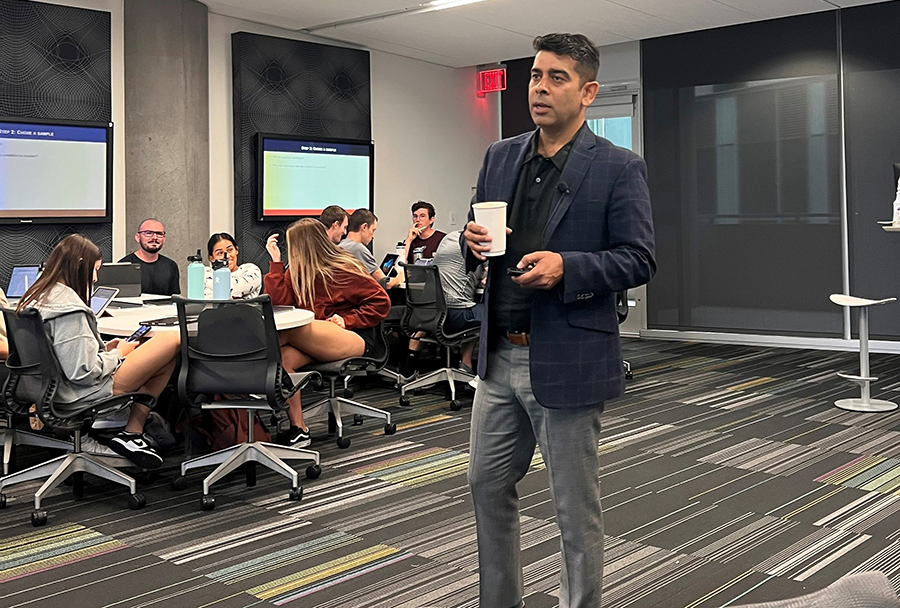
NAU’s Dr. Amit Kumar research receives R01 grant for stroke research
For stroke victims, demographics just may be their destiny. NAU professor Dr. Amit Kumar, is working to identify that pattern and change it.
Amit Kumar, an assistant professor in Northern Arizona University’s College of Health and Human Services on the Phoenix Bioscience Core recently received an R01 grant from the National Institute on Minority Health and Health Disparities to study the relationship between race/ethnicity, poverty and stroke treatment and recovery.
The five-year, $3.8 million award will enable Kumar to investigate how stroke victims’ race and income level factor into their post-stroke rehabilitation care and overall health outcomes. Research in this arena has uncovered a disturbing trend—right now, the two most pronounced disparities in stroke recovery occur in racial and ethnic minorities and adults with low socioeconomic status, which Kumar has codified as those covered by both Medicare and Medicaid. Studies have shown that having pre-existing comorbid conditions leads to poor health outcomes. Being a minority and from a poor socioeconomic status are akin to a pre-existing comorbid condition in health care.
“Growing up in a low-income farming family in the Bihar state of India, one of the world’s poorest regions, my family members had to travel for 15 hours to New Delhi for better care,” Kumar said. “I have also seen the prevalence of caste-based discrimination in India, which have some overlapping similarities to race-based discrimination. The persistent, systemic inequalities that affect the daily lives and health of minorities are a well-known epidemic with no vaccine.”
Kumar aims to fill in the gap of the quality and amount of rehabilitation care in in-patient facilities and how a patient who was hospitalized after an acute stroke and how that post-stroke care looks different for people of different ethnicities and socioeconomic status. Further, they don’t exactly know how different care amplifies the disparity.
“Identifying these disparities in care represent opportunities for health care providers to mitigate disparities in patient outcomes,” Kumar said. “Better, more equitable patient outcomes mean more stroke victims make a quicker, more extensive recovery.”
Read more about the research at NAU.edu.
More news from the PBC
- Discover Innovation at Connect Labs Phoenix
- Julie E. Bauman, MD, MPH, Joins the College as Inaugural Chair of Interdisciplinary Oncology
- ASU a partner in new national Foundry School announced by White House
- ARIZONA COMMERCE AUTHORITY ACCEPTING APPLICATIONS FOR THE FALL 2026 ARIZONA INNOVATION CHALLENGE
- ‘A monumental day’: Inaugural class of John Shufeldt School of Medicine and Medical Engineering receive white coats
- University of Arizona and Gila River Health Care Launch Nation’s First MD-Granting Medical School Branch within a Tribal Nation
- Arizona Grants $5M to Barrow for Clinical Trial of Ibogaine in TBI