

ASU professor of practice seeks to prepare students for careers in health care
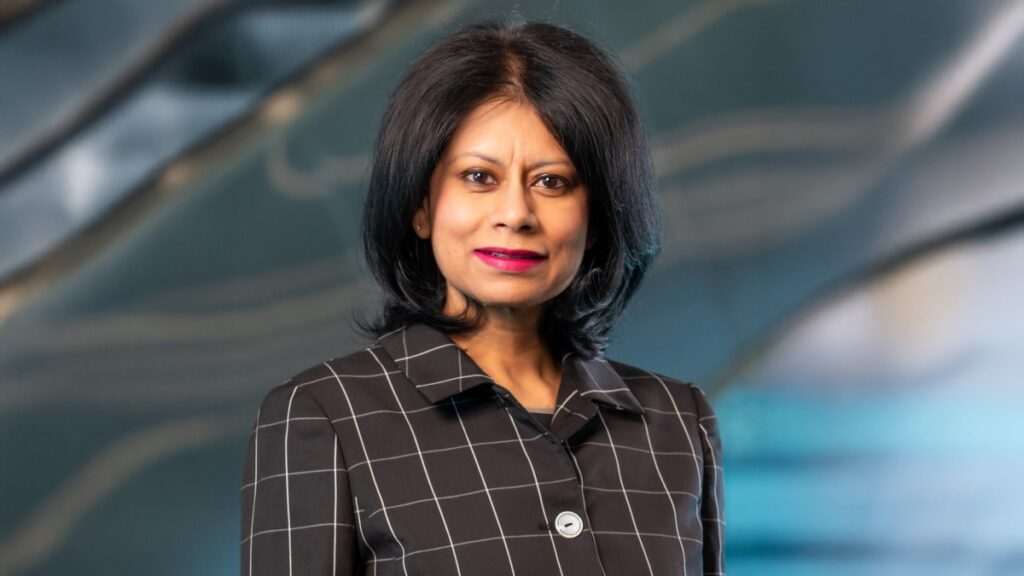
ASU College of Health Solutions Professor of Practice Roshini Moodley Naidoo. Courtesy photo
As an industry executive, Arizona State University College of Health Solutions Professor of Practice Roshini Moodley Naidoo routinely integrated value-based care into her day-to-day work. Now as the faculty lead for the Master of Science in health care administration and policy capstone, she prepares students to do the same in their own health care careers.
But what is value-based care? In its simplest form, value-based care is often thought of as an equation of quality over cost.
“Value-based care is more than an equation. It is a way of thinking that finds common ground between stakeholders in health care ecosystems. When we think about value-based care, we think of alignment and shared goals,” said Moodley Naidoo.
The question becomes: How can health care providers maximize quality while minimizing costs? This is the question Moodley Naidoo seeks to answer through her professional work and research at the College of Health Solutions as well as through a fellowship at her alma mater, Harvard University.
The Senior Fellows Program at the Harvard Kennedy School Mossavar-Rahmani Center for Business and Government involved two key portions: research and thought leadership. Moodley Naidoo began the fellowship in 2023 and, during this time, participated in a collaborative forum for senior fellows, where she received mentorship from Professor Joseph Newhouse while writing and publishing research. In addition to this, Moodley Naidoo taught current Harvard graduate students, bringing in guest lecturers to share their practices and facilitate the transfer of knowledge.
Though the fellowship traditionally lasts one year, Moodley Naidoo was invited to continue her work as a senior fellow for an additional year, yielding two published works and two working papers studying the barriers to implementing value-based care within that time. She focused her research on artificial intelligence’s applications within value-based care, finding that it has great potential to limit costs and improve quality of care.
Now, after completing her fellowship, Moodley Naidoo returns to the College of Health Solutions to assist graduate students with gaining real-world experience through the capstone program. Working alongside local health care organizations such as HonorHealth, Banner Health, Blue Cross Blue Shield AZ and Native Health, students are supervised by leaders within their organization while receiving Health Solutions faculty mentorship and support.
Question: How did you combine your work in value-based care with artificial intelligence in your research?
Answer: This is an exciting topic and still evolving. What’s crucial, for AI to enable value-based care, is for AI solutions to explicitly reduce costs and improve the quality of care. One technology, for example, that we studied was virtual scribes that function as natural language processing technology.
In the traditional non-scribe office, you would have the physician sitting around the laptop, usually accessing an electronic health record, typing notes, with not much time spent with the patient. If you think about how physicians work, they have very limited time from one patient to the other due to how their work schedules are organized. The physician thereafter would use what’s tellingly called “pajama time,” to complete writing up the patient’s notes. Understandably, this process can be very onerous, and is often cited as a culprit for physician burnout, negatively affecting the physician-patient relationship. A virtual scribe relieves that burden, because a virtual scribe does the note-taking in real time. It’s an ambient listening system, so the physician has to take almost no notes while the engagement is happening.
So that’s AI-enabled care, right? What’s happening in the new virtual scribe environment is the nature of the communication between the physician and the patient is improving vastly, which means the physician can spend time on things that are really critical to the patient, which might not always be possible in the more traditional way. It is expected that the patient has a better experience and is more likely to follow the physician’s instructions, leading to improved quality of that encounter.
Where the cost comes in is reducing wasteful care. If a physician-patient encounter is rushed and communication is unclear, lots of things that should be done are not done, and vice versa. That can be very costly to the health care system, and also lead to very poor outcomes for the patient. That’s a good example of how a virtual scribe, if designed correctly, can both reduce costs, as well as improve quality outcomes.
Q: Why did you choose this field? What interested you most?
A: What’s new now and what’s quickly evolving is AI coming into the space, but value-based care, for me, was not new. In my industry role, since I was responsible for risk management, it was my job to remove waste from the health care system. I had studied quality improvement at graduate school, and value-based care was the perfect way for me to use my quality learning to reduce costs.
My fellowship allowed me to switch gears a bit and think about value-based care — instead of a practitioner, (it was) more from a research perspective, a forward-looking perspective, because when you’re a practitioner, to some degree, your constraints are what you can implement within tight timelines. My company was publicly listed, so the timelines were even shorter. As a researcher and as a teacher, as an educator, you don’t have that constraint. You can be forward-looking, you can think about what’s coming in two years, in three years.
So that’s what I enjoyed doing. I could think very intentionally about new solutions from different perspectives and contemplate implications for the future through a multifaceted lens. I am very fortunate to work with professors Bill Riley and Matt Martin at (the College of Health Solutions), where we work to take research insights rapidly into practice. This closes the loop very meaningfully.
Q: What do you foresee for the future of value-based contracting?
A: One part of me is just the optimist, so I want to absolutely believe that this is going to continue to grow, and it has. It has grown tremendously in the United States, as well as globally. However, I do think that there are reducing pressures and dynamics. So beyond just aspiration and optimism, there is also reality.
Health care is becoming much more expensive, and patients struggle with costs. There are wasteful pockets of care as well that have to be addressed. Outcomes ought to be the best for the amount of funds that are spent on health care. Value-based contracting allows those challenges to be addressed. So just for that reason, it is important that value-based care continues to grow. It’s a good organizational model to advance care.
The information asymmetry that exists between patients and health care systems is going to rapidly close with AI as more clinical information becoming available to patients. As patients become more knowledgeable and empowered about their care, I think patients themselves will gravitate toward models that are value-enhancing. It will be truly meaningful if patients become champions of value-based care.
The ideal health care system is seamless to navigate, where it’s one person coordinating care and care journeys (are) easily understood. So, with that happening — and largely enabled by AI, by information — I think that will be another enabler of value-based care in the medium term.
Q: What is your proudest accomplishment?
A: I would think about it twofold. It’s very much about being a mentor. I especially enjoyed supporting people at the early stages of their careers. Being there when someone I mentored got their first promotion would always be the proudest moment.
Personally, it’s also very much about being a mom. I’ve always tried to blend both my home and professional worlds. I don’t know if my children would say I blended very well, but I do take my journey as a mom as a source of pride and inspiration.
By: Eden Miller | September 24, 2025 | Original Post