
Researchers, public officials and community partners will work together to help communities prepare for worsening extreme heat
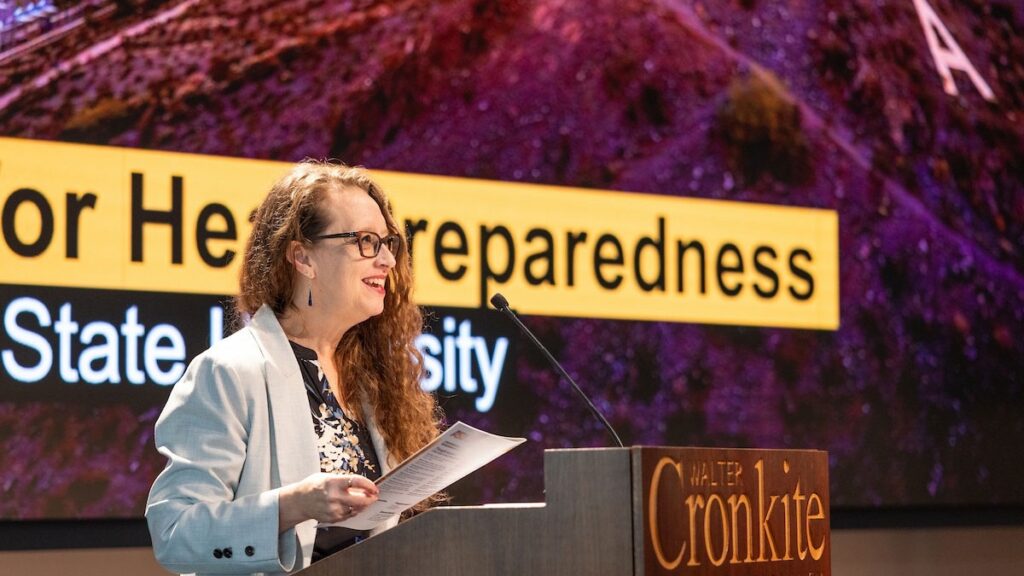
After a summer of record-breaking heat, two things brought relief on Monday — a rare day of rain in the Valley and the launch of Arizona State University’s Center for Heat Preparedness.
The center, the first of its kind in the nation, will bring together ASU experts and nearly 200 skilled researchers and scientists to develop strategies that help cities prepare for worsening heat, which officials say is more dangerous than ever and getting worse.
The launch was celebrated Sept. 28 with a reception at ASU’s 850 PBC building in downtown Phoenix, where university and community leaders, ASU researchers and other partners gathered for the occasion.
“Here in Arizona, heat is not an abstract issue, and it’s not a future threat,” said Sally Morton, executive vice president of ASU’s Knowledge Enterprise, who kicked off the reception. “It’s part of our daily reality.”
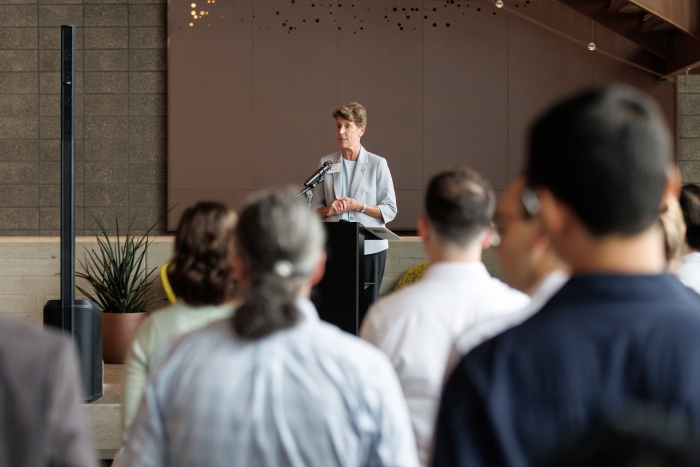
This August was the hottest month ever reported globally, and extreme heat is the leading cause of weather-related deaths in Phoenix, across Arizona and much of the Southwest. Morton said Arizona’s longer heat seasons, rising temperatures and growing health risks give the state both a responsibility and an opportunity to lead.
“The Center for Heat Preparedness is designed to move us from response to readiness,” she said.
During the launch, Morton announced that Patricia Solís will serve as the center’s executive director. Solís, a research professor in ASU’s School of Geographical Sciences and Urban Planning, has worked extensively with communities, state leaders and federal officials on heat-related issues, and will coordinate researchers from across the university.
The center was established with federal funding secured with the support of U.S. Reps. Yassamin Ansari and Greg Stanton, and provided through the National Institute of Standards and Technology.
Phoenix Mayor Kate Gallego said the center comes at a critical time for Arizona, which is on the front lines of extreme heat but is also emerging as a leader in developing solutions. Gallego said research from ASU has already helped the city assist residents of manufactured housing, establish nearly 100 heat-relief sites, and deploy emergency resources that have saved lives.
“We try to have the city of Phoenix take this data and put it into action to make sure we make as much progress as we can,” Gallego said. “We treat extreme heat as the public health emergency that it is. We plan year-round.”
She said the work taking place in Phoenix also has implications far beyond Arizona. Phoenix has shared its experience with cities such as London, where officials are confronting questions about protecting firefighters and vulnerable residents during increasingly severe heat waves.
“That’s just one example of how the work that happens here at ASU and in Phoenix helps save lives throughout the world,” Gallego said.
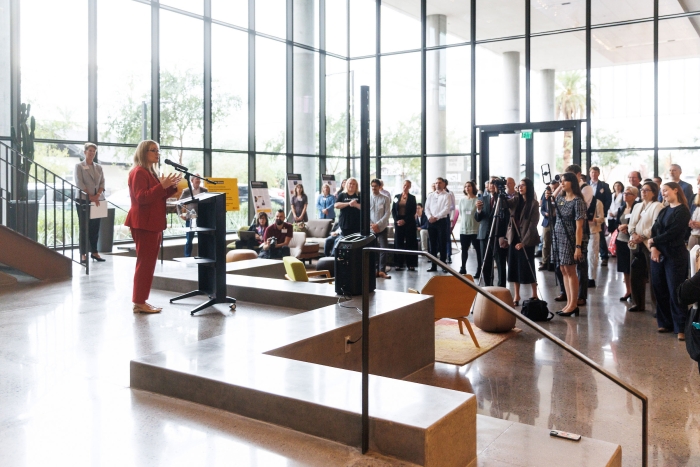
Ansari, who worked on heat-related initiatives while serving on the Phoenix City Council, said Arizona has emerged as a national leader in confronting extreme heat. Phoenix created the nation’s first publicly funded municipal office dedicated specifically to heat response and mitigation.
But addressing the growing threat will require cooperation among universities, governments, utilities, health systems, first responders, nonprofit organizations and residents, she said.
“The government cannot meet these challenges alone. Universities cannot meet these challenges alone,” Ansari said. “ASU is creating a place where research can be shaped by real community needs and where strong ideas can become solutions that save lives.”
Stanton called extreme heat “a silent, slow killer” as well as a costly economic threat. Although Arizona has invested in cooling technology, emergency services and heat-relief networks, hundreds of residents continue to die from heat-related causes each year, he said.
So far, there have been 230 confirmed heat-related deaths in Maricopa County in 2026, a 60% increase from this time last year.
“But here’s the hopeful part: These deaths are preventable,” Stanton said. “We need to adapt — and faster — to a hotter world.”
Stanton said the center will turn research into solutions by improving electrical-grid modeling, helping cities reduce urban heat islands and identifying better ways to distribute cooling resources. Its educational efforts could also help Arizonans understand how medications and underlying health conditions may increase their vulnerability to heat.
“Washington doesn’t have all the answers,” Stanton said. “But I have no doubt that many of the answers will come from the people in this room — the students and the researchers here at Arizona State University.”
The cooling effect of collaboration
Monday’s reception was followed by the Extreme Heat and Health Governance Symposium
Scott Barclay, interim vice president of research for ASU’s Knowledge Enterprise, opened the event by describing one of the center’s primary goals: to bring better coordination to the heat research already underway across the university.
Barclay pointed to the response to natural disasters such as Hurricane Katrina as a model for collaboration. Urban planners, government agencies, engineers, social scientists, policymakers and thousands of researchers came together to develop action plans, guide policy and rethink how communities and landscapes are designed.
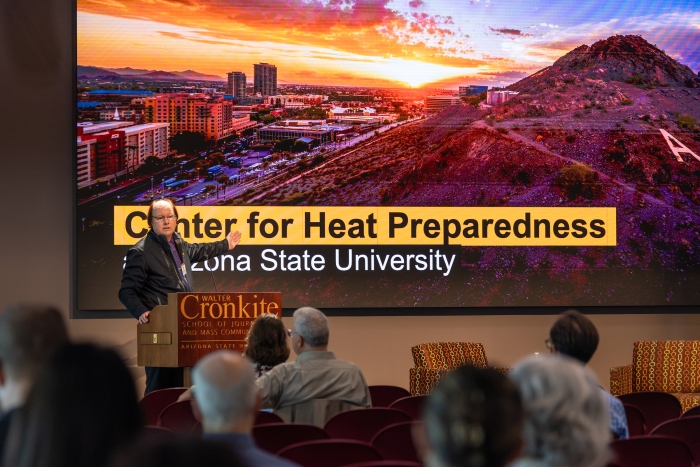
Hundreds of people are similarly engaged in heat-related work across a range of disciplines, Barclay said, but many remain on the margins of the broader conversation. The center aims to connect those efforts and bring more researchers into a coordinated response to extreme heat.
“What do we hope to achieve practically out of the Center for Heat Preparedness?” Barclay asked. “I think for us, the key answer to that is coherence.”
The center will unite researchers with government agencies and communities to develop strategies that can save lives, strengthen infrastructure and help cities and rural communities become more resilient.
“We want a coherent conversation that puts it all on the table and shows the connection points so that we can work faster, better and more effectively,” Barclay said.
Barclay then introduced Solís, who led the symposium’s keynote conversation with Deirdre Dalpiaz Bishop, associate director for economic programs at the U.S. Census Bureau.
Solis said one of the ways we work together is through data. Their discussion demonstrated how partnerships and detailed local data can help communities identify residents who face the greatest risks from extreme heat.
“This (heat threat) is a challenge that is urgent, complex and deeply human,” Solís said. “How we understand, prepare for and respond to heat is through the data that we use.”
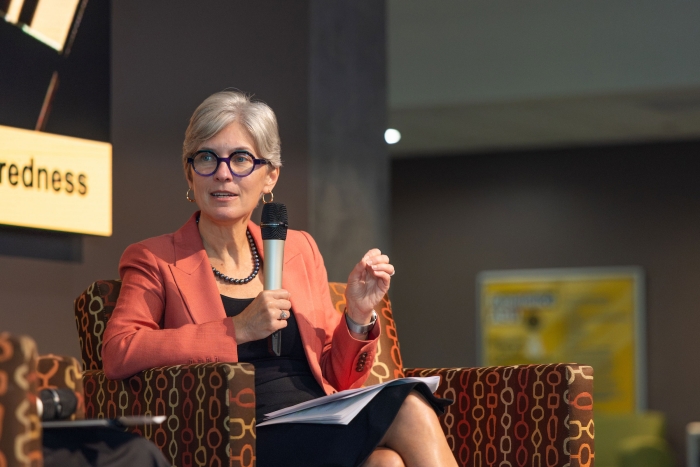
The two began working together on heat vulnerability after Bishop visited ASU in 2019 to discuss the Census Bureau’s Community Resilience Estimates, which use factors such as income, education, age and health to identify populations that may have difficulty recovering from disasters.
Solís challenged the Census Bureau and ASU researchers to develop a product specifically focused on heat, leading to the creation of the Community Resilience Estimates for Heat.
That collaboration also contributed to the Census Bureau’s new Local Air Conditioning Estimates, which provide estimates of air-conditioning access at the national, state, county and census-tract levels.
The neighborhood-level data can reveal disparities hidden by countywide figures. Bishop said the estimates show that about 3% of households in Graham County lack air conditioning. Within individual census tracts, however, the estimates range from 0.2% to more than 16%.
“That’s the value of being able to apply the local knowledge, the local approach and the local data to better tell the story and then, of course, make good decisions,” Bishop said.
Heat solutions on the horizon
The final discussion of the day focused on several questions: How can we celebrate and build on what is working while recognizing what remains to be done? And how can we ensure that the next generation of approaches to heat and health is not only effective, but shaped, shared and owned by everyone?
Eugene Livar, Arizona’s chief heat officer, said the state has strengthened coordination among agencies, expanded its network of cooling centers and other heat-relief sites, and made heat information more accessible. The next step, he said, is moving from a reactive response to long-term preparation.
“We really need to shift away from that seasonal, short-term kind of approach when we’re dealing with heat,” Livar said.
Panelists also emphasized the importance of including rural and tribal communities in heat planning, tailoring public health messages to different populations and involving residents in designing solutions for their own neighborhoods.
We really need to shift away from that seasonal, short-term kind of approach when we’re dealing with heat.Eugene LivarArizona’s chief heat officer
Maren Mahoney, director of the Arizona Governor’s Office of Resiliency, closed the symposium by explaining that heat is more difficult to define and respond to than sudden disasters such as hurricanes or floods. It has no clear beginning or end, yet its effects extend across public health, infrastructure, utility costs, the electrical grid and the economy.
“What does it mean for governments to be prepared for heat?” Mahoney said. “It means building data sets, advancing knowledge. It means understanding gaps in our systems that result in thousands of emergency room visits and hundreds of deaths each year, and then investing long term in filling those gaps.”
Mahoney said governments need research, policy models and partnerships that can turn knowledge into action.
“As we build toward a warmer but more resilient future, knowledge development and collaborative initiatives will become so much more important,” she said. “The Center for Heat Preparedness will be foundational to that future.”
By Dolores Tropiano | October 01, 2026