
Initiative, new course reflect broader commitment to recognizing AI as a necessary tool for nursing

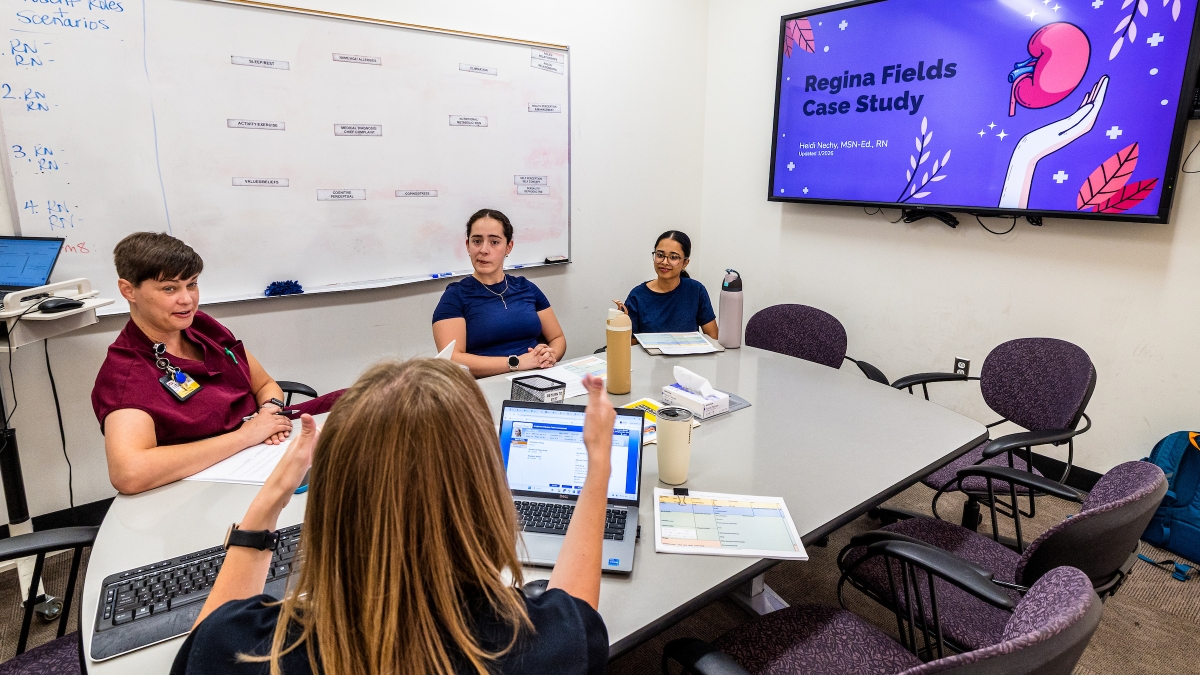
From left: Clinical Assistant Professor Heidi Nechy, fourth-year nursing student Nefertari Rincon and third-year nursing student Bharati Attreya listen as Clinical Assistant Professor Jessica Gentes describes a simulated case study with assistance from Avery, an agentic AI nurse assist, on Thursday, July 9. Photo by Charlie Leight/ASU News
Regina Fields is a 35-year-old woman with an acute kidney injury. She’s short of breath, nauseous and having trouble urinating.
The nurses taking care of Fields have questions about her condition, so they ask their coworker Avery, who immediately responds with the information they need.
It’s a scenario that plays out every day in health care.
But, in this case, Fields is fictional, the three nurses studying Fields’ case are students in the Edson College of Nursing and Health Innovation, and Avery is an agentic AI nurse assist using its chatbot function to answer the nurses’ questions.
The simulated case study is part of Edson’s yearlong Avery AI Nurse Assist Evaluation Initiative, in which the college is evaluating Avery’s mastery of knowledge to determine if it can be a useful, ethical and trustworthy aid to patients and care teams.
Project manager Brendan Fields said the initiative is part of Edson College’s broader commitment to recognizing AI as a necessary tool for nursing.
The undertaking also includes a new course that debuts this fall, which will equip students with the evolving knowledge, skills and attitudes needed to demonstrate AI literacy and use AI safely, ethically and effectively in health care settings.
“My hope is that the students leave the course with confidence in using AI thoughtfully and intentionally throughout their educational journey and professional practice,” said Celia Coochwytewa, assistant director of academic operations in the Edson College. “They should walk away with the curiosity to question its outputs and the ability to recognize where human expertise is essential.”
The course acknowledges, as Margaret Calacci, director and clinical associate professor in Edson’s nursing prelicensure program, put it, that “AI is part of health care now.”
For the last several months, Avery has been fed all the information — lectures, readings, handouts, etc. — that Edson nursing students would learn in their prelicensure program. And just as students are graded in their simulations, Avery will be as well.

The Avery initiative is part of a broader collaboration between Drive Health, an Arizona-based company, and ASU Health that seeks to examine how agentic AI — like Avery — can address the health care needs of the state and beyond.
Kevin Longoria, CEO and co-founder of Drive Health, the company that produced Avery, said the partnership with ASU and Edson’s evaluation will help determine whether Avery is “noninferior” to human nurses and can be used in the health care system.
“She’s never going to be able to do all of the amazing things that a nurse can do, but these really time-consuming things … that’s what we’re evaluating,” Longoria said. “So we want to get an approval from ASU that says she is safe to use.”
“Our goal,” Calacci added, “is to see if we can validate her knowledge and interactions with patients.”
Longoria said the agentic AI nurse assist was developed in part because there are not enough nurses in underserved communities. According to a report by the Baylor College of Medicine, only 16% of registered nurses work in rural areas.
“The thesis here is we need actual labor in health care,” he said. “We have this finite supply of amazing nurses, but the idea with Avery is that someone is there for the patients 24 hours a day, seven days a week, when unfortunately, the human nurse can’t.”
Longoria said Avery, which has launched in 19 languages and could be expanded to more than 70, has several potential uses.
For example, Avery could potentially communicate with patients who have just been discharged from a hospital and aren’t sure about which medications to take or what they can and can’t do.
“While you’re at the hospital, patients are distressed or confused,” Longoria said. “But they don’t want to bug the doctors or the clinicians because they know their time is valuable. And they don’t want to feel stupid. So this is a great opportunity to reengage. Avery can call every patient that walks out of a facility, as an example, and within 24 hours, in their native language, they understand exactly what they’re supposed to do.”
Avery also could connect with patients after a doctor’s office visit.
“Avery would be that interactive piece connecting with you after your appointment, making sure you understand your medications or seeing if you need to schedule a follow-up,” Calacci said. “She can provide feedback if a patient has questions about swelling or a wound, for example.”
All of this would happen under the supervision of a nurse.
“We think it will help nurses do a better job,” said Judy Karshmer, dean of the Edson College. “There are several tasks that are just time-consuming. Writing reports. Doing discharge plans. Right now, you leave the hospital, and a nurse gives you three pages’ worth of stuff you never read. Avery will be able to say, ‘Bob, this is what happened in the hospital. This is what to expect.’”
Karshmer said if the evaluating goes well, ASU could give its seal of approval to Avery by the end of 2027.
“We think it is going to be a huge addition to personalized health care,” Karshmer said. “But it’s important to say that it’s not replacing nurses. That’s why we talk about it as a tool for the nurse.”
By Scott Bordow | July 14, 2026 | Original Post