
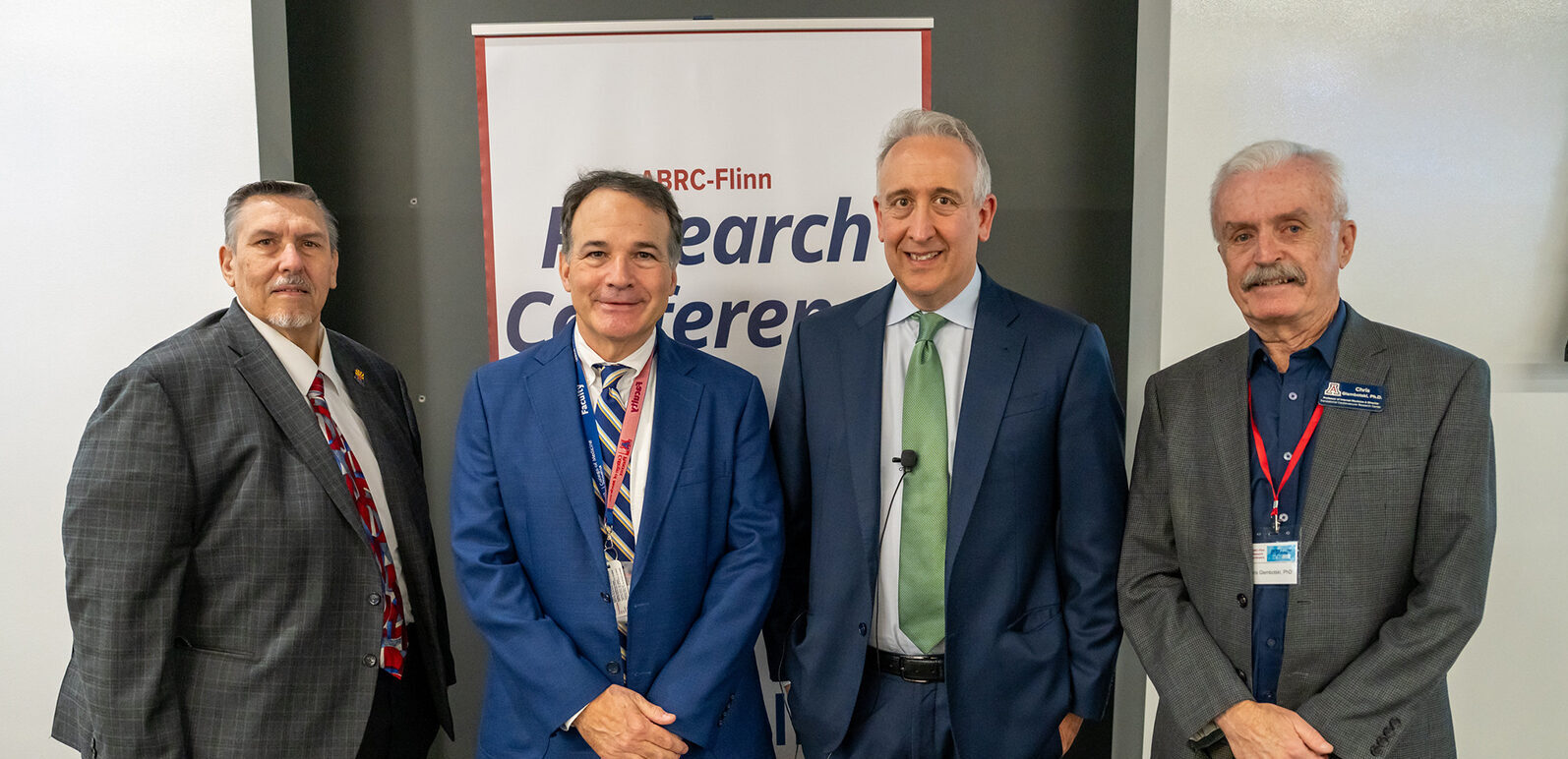
John S. Garcia, MBA, CPM, program director at the Arizona Biomedical Research Centre, Dean Fred Wondisford, MD, MS, MBA, Corey Casper, MD, MPH, and Chris Glembotski, PhD.
Conference’s keynotes spotlighted emerging technologies to improve a myriad of cancer therapies
A pillar of the University of Arizona College of Medicine – Phoenix’s ongoing Strategic Plan is driving research discovery to help fuel a healthier future for all Arizonans. For the 11th year, the Annual Arizona Biomedical Research Centre (ABRC)-Flinn Research Conference demonstrated how the college and its associates are doing exactly that.
Chris Glembotski, PhD, vice dean of Research and director of the Translational Cardiovascular Research Center, opened the event, thanking the ABRC and the Flinn Foundation for their invaluable partnership. “This conference is meant to celebrate their participation with the University of Arizona College of Medicine – Phoenix; and in terms of building our research enterprise, I want to recognize the leadership [John S. Garcia, MBA, CPM, program director at the ABRC, and Mary O’Reilly, PhD, vice president of Bioscience Research Programs at the Flinn Foundation] from those organizations,” he said.
Dean Fred Wondisford, MD, MS, MBA, built on Dr. Glembotski’s remarks, sharing the enormous economic impact of the U of A College of Medicine – Phoenix on the city. 1“This school contributes $464 million per year to the local economy,” he said. “It’s not just the research we have here, but it’s also the people that are employed here. And we couldn’t do this without the support of the Flinn Foundation and the ABRC.”
This year, the conference welcomed distinguished speakers Corey Casper, MD, MPH, professor and clinical scholar in the Department of Internal Medicine at the College of Medicine – Phoenix and chief research officer with Banner Health, and Ekokobe Fonkem, DO, vice chair and professor of Neurology, to give the morning and afternoon keynote presentations.
Corey Casper, MD, MPH
Dr. Casper’s talk, New Technologies for the Immunotherapeutic Prevention and Treatment of Disease, focused on how he developed a passion for biomedical research, as well as how he has worked to change the way physicians and researchers think about health and disease.
“Research begins with asking a simple question,” Dr. Casper said. In the case he presented, it was why one cancer in Uganda — despite having the same histopathological and pathogenic mechanisms — looked so different from the same cancer in the U.S. And that particular instance is what drove the rest of his work.
“That was the beginning of a research career, where I actually moved and worked in Uganda for about 15 years — asking questions about what was the basic biology of cancer, how did the immune system control infection-related cancers and what can we learn from that in terms of deriving new therapies?”
The takeaway: it’s vital for clinicians to ask clinical questions when they encounter something foreign at the bedside. They can then use those questions to conduct rigorous translational science and develop new therapies for the diseases they’re studying.
Dr. Casper then touched on the emergence of immunotherapies and how physicians can extend the promise they provide. Research has shown the dramatic impact immunotherapies can have on the effectiveness of treatments. As an example, the shingles vaccine went from roughly 50% effectiveness to 97%. The problem: the cost can be exorbitant.
“The latest immunotherapy drug that was licensed in the United States is $1 million a dose,” Dr. Casper explained. “In 2022, the average cost of a course of immunotherapy — $260,000. And in Washington state, 40% of cancer patients are bankrupt at the end of their cancer treatment. We need to do better than we’re doing right now.”
To help with that, Dr. Casper proposed two technologies he currently works on: adjuvants and RNA vaccines. Adjuvants stimulate a person’s innate immune system. “We have pattern receptors on our immune cells that are looking for these signals, like single stranded RNA, and activate your immune system to act in a nonspecific way to amp up your immune responses,” he said.
“The thought is: We can use these to make better vaccines and better cancer therapies,” he added.
Ekokobe Fonkem, DO
Dr. Fonkem’s presentation, New Paradigms in Neuro-Oncology, centered on his work to improve the way brain tumors are diagnosed and treated. Though they only account for 1.4% of all cancers, brain tumors result in 2.4% of cancer-related deaths.
That discrepancy is due to a multitude of factors. Generally, malignant gliomas have multiple disordered pathways and mutated targets; lack strong disease biomarkers; are shielded by the blood brain barrier; have a limited therapeutic window; are known for the rapid development of resistance to potential treatments; and require imaging — like an MRI — for diagnosis.
One therapy Dr. Fonkem presented is a way to open the blood brain barrier at a desired location through focus ultrasound. In their research, the penetration and delivery of leading drugs through this method has shown marked improvement.
“If you look at some of the traditional chemotherapy — like carboplatin — you see that with this focus ultrasound, you are able to get more than six times the amount of carboplatin into the brain,” he said. Similar success was achieved with a common drug used to treat glioblastoma, where the results showed a 140% enhancement of delivery.
“We are very excited with this technology because we think this is the way neuro-oncology is going to go,” Dr. Fonkem said. “Perhaps, this might be how we’ll try to use what we know in science to find new treatments for some of these very difficult to treat diseases.”
In addition, Dr. Fonkem shared his ongoing work with a more targeted approach to treatment through the PI3K group of enzymes; his study on whether a Ketogenic diet can slow tumor progression; and his work on Optune — using the principles of electricity to disrupt tumor mitosis (cell proliferation).
Throughout the rest of the day-long conference — which drew more than 240 attendees — grant awardees from the ABRC and the Flinn Foundation also showcased their research advances through poster and oral presentations. The conference concluded with a networking reception.
Photos from the event
1This number comes from an independent report — The Economic Impact of the University of Arizona College of Medicine – Phoenix: Past Estimates, Current Performance, and Future Transformation Impacts — compiled by Tripp Umbach in November 2025.
About the College
Founded in 2007, the University of Arizona College of Medicine – Phoenix inspires and trains exemplary physicians, scientists and leaders to advance its core missions in education, research, clinical care and service to communities across Arizona. The college’s strength lies in our collaborations and partnerships with clinical affiliates, community organizations and industry sponsors. With our primary affiliate, Banner Health, we are recognized as the premier academic medical center in Phoenix. As an anchor institution of the Phoenix Bioscience Core, the college is home to signature research programs in neurosciences, cardiopulmonary diseases, immunology, informatics and metabolism. These focus areas uniquely position us to drive biomedical research and bolster economic development in the region.
As an urban institution with strong roots in rural and tribal health, the college has graduated more than 1,000 physicians and matriculates 130 students each year. Greater than 60% of matriculating students are from Arizona and many continue training at our GME sponsored residency programs, ultimately pursuing local academic and community-based opportunities. While our traditional four-year program continues to thrive, we will launch our recently approved accelerated three-year medical student curriculum with exclusive focus on primary care. This program is designed to further enhance workforce retention needs across Arizona.
The college has embarked on our strategic plan for 2025 to 2030. Learn more.
By: Thomas Kelley | May 28, 2026 | Original Post