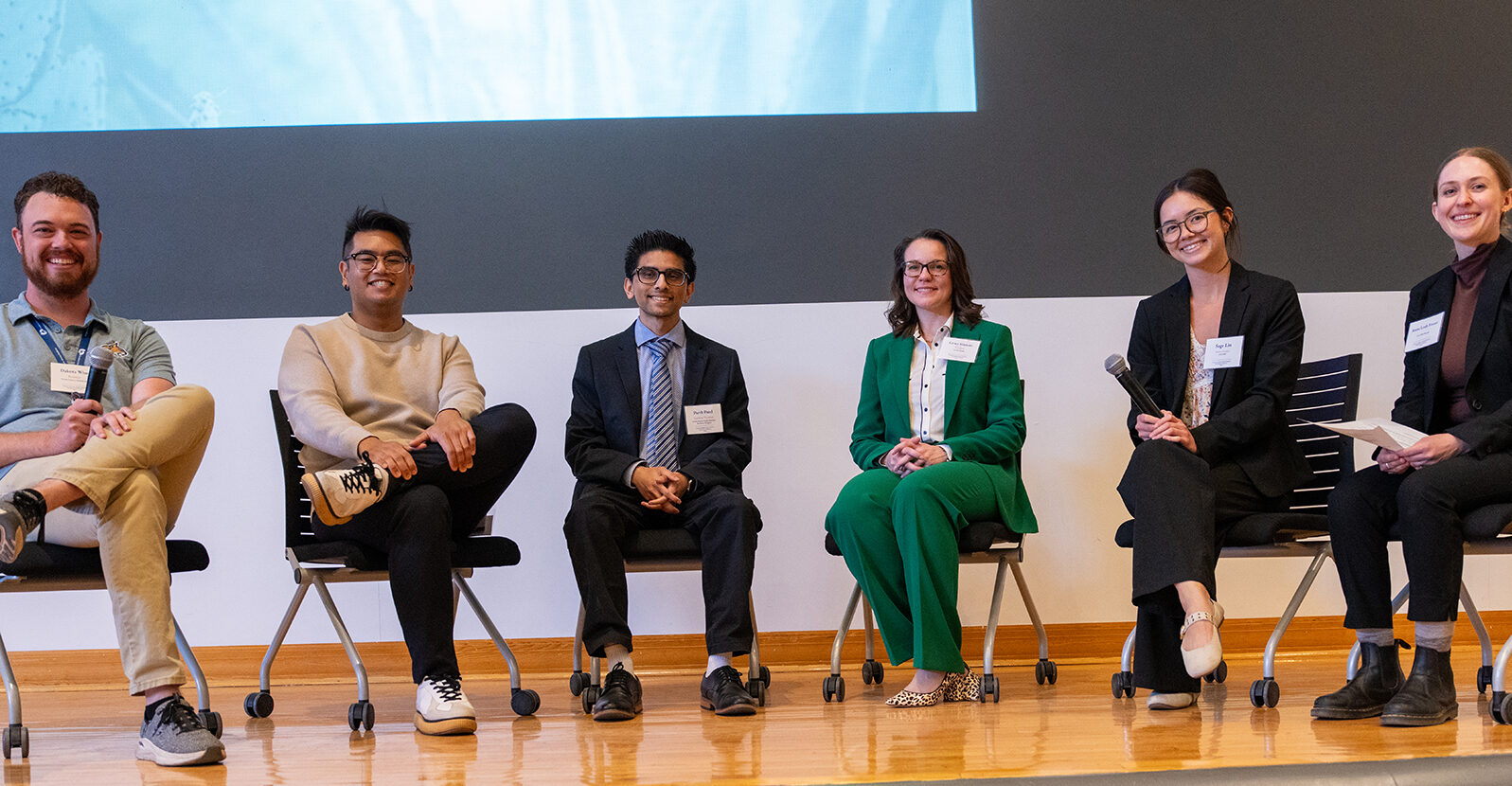
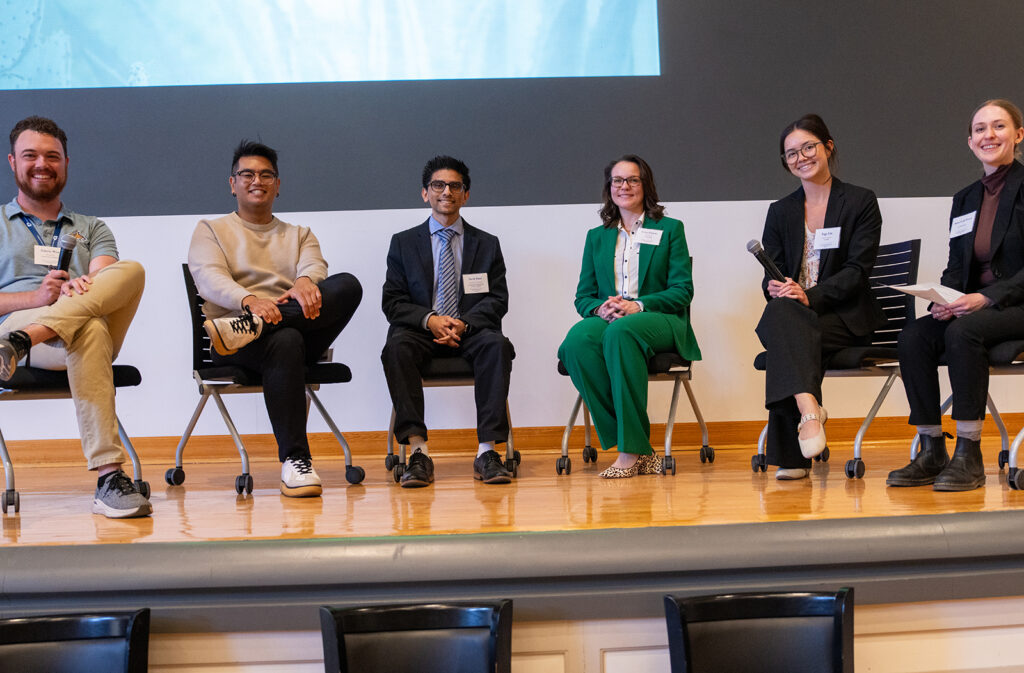
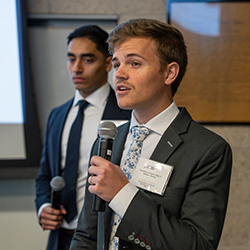
Medical students Sage Liu and Anna Leah Eisner (far right) moderated the “What’s Family Medicine Really Like?” panel.
Day-long conference featured keynote talks, as well as panels and research presentations
A key initiative to the University of Arizona College of Medicine – Phoenix’s five-year Strategic Plan is leveraging partnerships to enhance growth, innovation and excellence — ensuring a better future for the health of Arizonans and beyond.
The Arizona Academic Family Medicine Innovation Conference (AAFMIC) embodies that focus. Hosted Friday, April 17, on the college’s campus, AAFMIC is a premier gathering of medical professionals, educators, researchers and students that is dedicated to advancing family medicine through research, collaboration and innovation. Encouraging academic and research activity in the state, it has a strong focus on knowledge sharing between programs and institutions.
Leah Hillier, MD — an associate clinical professor of Family, Community and Preventive medicine, who helped plan and organize the conference — touched on what made this year’s conference so crucial. “We have to do more research in family medicine environments. Almost a quarter of outpatient visits in the U.S. take place in family physicians’ offices, positioning family medicine as the best place to pilot interventions that are not only innovative, but also practical, feasible and sustainable.”
“Research in family physicians’ offices is critical to developing scalable solutions in health care. AAFMIC encourages research culture in family medicine and features the spectacular scholarly work that is being done across Arizona by family medicine residents and faculty,” she added.
The conference’s two keynote presentations further stressed that need and provided insight into how partnering with collaborative research entities can prove beneficial for the patients of the physicians who attended.
Your Practice is Your Laboratory with Nicholas Pimlott, MD, PhD
Clinical discovery in family medicine is relevant and important. And there is historical precedence for this line of thought. Dr. Pimlott — a professor in the Department of Family and Community Medicine, Temerty Faculty of Medicine at the University of Toronto and editor of Canadian Family Physician — presented those ideas through a series of examples — such as Dr. Wiliam Norman Pickles’ work with infectious hepatitis.
“It’s long been known that in family practice, patients present with symptoms, not with diseases,” he said. “It’s also long been known that symptoms can be both the signifiers of underlying disease and an expression of the patient’s experience of illness.”
Since family medicine physicians often encounter an unknown illness at its earliest stages, they can chart how it evolves and manifests itself — allowing them to provide more contextual detail, as well as describe the natural history of the illness and the circumstances surrounding its onset. That knowledge is invaluable.
“First, for any disease, we see the whole range from the mildest cases to the most severe, so we are in a position to give a fuller description than a referral clinic,” Dr. Pimlott explained. “Second, because of our long-term relationship with patients, we can follow them for long periods and can obtain very complete follow up using tracing strategies.”
Historically, the barrier to further understanding what they were encountering was due to the lack of interconnectivity between practices. With the benefit of technology — like the electronic medical record — that gap has been bridged. The opportunity for discovery to originate within family medicine has never been greater — a point Sally Radovick, MS, MD, expanded on in her presentation.
CTSA and SW CACTI with Dr. Sally Radovick
In her talk, Dr. Radovick — a professor of Pediatrics and director of the Clinical and Translational Research Institute at the U of A College of Medicine – Tucson — detailed what a Clinical and Translational Science Award (CTSA) is, as well as the mission of the newly formed SW CACTI. She then explained how it can aid family medicine practitioners in furthering their work.
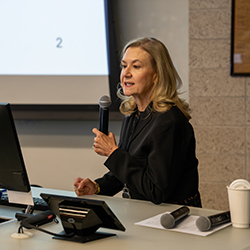
A partnership between University of New Mexico Health Sciences, the U of A Health Sciences and Banner Health, SW CACTI is a translational science and research center that promotes interdisciplinary collaboration, focused training, education and cutting-edge research methods. It is funded through a $43.6 million CTSA from the National Institutes of Health (NIH) National Center for the Advancement of Clinical and Translational Science.
As Dr. Radovick detailed, that sort of funding and cross-institutional teamwork is important in many ways for fostering research breakthroughs. “CTSA institutions conduct 20% more clinical trials and achieve 42% higher clinical trial enrollment,” she said. “CTSA supported manuscripts were cited over twice as often as comparable NIH-funded papers. Multi-institutional hubs had nearly 60% more publications and citations than single institution hubs.”
For Dr. Radovick, the effect that a CTSA, and SW CACTI in particular, can have for family medicine physicians can be manifested in a multitude of ways. It can accelerate translation of discoveries into improved health, enabling them to lead practice-based, patient-centered research; shorten the path from evidence to impact in primary care; institutionalize alliances with health systems and communities, breaking down traditional barriers; provide access to patients, data and practice-based research infrastructure; expand funding opportunities for family medicine; strengthen training and career development; and can elevate the impact of family medicine both institutionally and regionally, as it signals that a practice values primary care that is driven by translational science.
“[SW CACTI] provides the infrastructure, the training programs and the partnerships with the hubs that allow family medicine innovations to scale across the Southwest,” Dr. Radovick said.
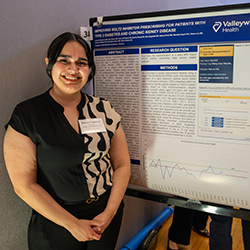
The day-long event also featured series of short talks by medical students, faculty and family medicine residents at hospitals from around Arizona — including the U of A Colleges of Medicine in Tucson and Phoenix, Onvida Health and HonorHealth — as well as multiple panels and an array of research posters.
The research featured topics ranging from how to better develop cultural competency in medical practice to utilizing emerging technologies to improve the efficiency of resident note taking.
The panels, which ran concurrently, shed light on what family medicine residency is really like, as well as how to center the community in family medicine research. The former was moderated by Sage Liu and Anna Leah Eisner, College of Medicine – Phoenix medical students with the Class of 2028 and 2026 respectively.
The conference concluded with a Family Medicine Recruitment Fair hosted by Arizona Academy of Family Physicians. Now in its fourth year, the AAFMIC has grown tremendously — growing from 30 participants in its first year to over 150 this year.
About the College
Founded in 2007, the University of Arizona College of Medicine – Phoenix inspires and trains exemplary physicians, scientists and leaders to advance its core missions in education, research, clinical care and service to communities across Arizona. The college’s strength lies in our collaborations and partnerships with clinical affiliates, community organizations and industry sponsors. With our primary affiliate, Banner Health, we are recognized as the premier academic medical center in Phoenix. As an anchor institution of the Phoenix Bioscience Core, the college is home to signature research programs in neurosciences, cardiopulmonary diseases, immunology, informatics and metabolism. These focus areas uniquely position us to drive biomedical research and bolster economic development in the region.
As an urban institution with strong roots in rural and tribal health, the college has graduated more than 1,000 physicians and matriculates 130 students each year. Greater than 60% of matriculating students are from Arizona and many continue training at our GME sponsored residency programs, ultimately pursuing local academic and community-based opportunities. While our traditional four-year program continues to thrive, we will launch our recently approved accelerated three-year medical student curriculum with exclusive focus on primary care. This program is designed to further enhance workforce retention needs across Arizona.
The college has embarked on our strategic plan for 2025 to 2030. Learn more.
By: Tom Kelly | April 29, 2026 | Original Post