


Chris Glembotski, PhD, Shanna Hamilton, PhD, Leslie Leinwand, PhD, Shirin Doroudgar, PhD, Sakthivel Sadayappan, PhD, MBA, professor and department head of Cellular and Molecular Medicine at the College of Medicine – Tucson, and Tobias Jakobi, PhD, at the symposium.
The 18th annual meeting showcased developments in physiology research
The 18th Arizona Physiological Society Annual Meeting, hosted at the University of Arizona College of Medicine – Phoenix’s campus, consisted of two days of talks, seminars and poster presentations demonstrating new research developments in physiology.
With opening remarks from Shirin Doroudgar, PhD, an associate professor in the U of A College of Medicine – Phoenix’s Department of Internal Medicine and the president of the Arizona Physiological Society, the conference featured cutting-edge research presentations by undergraduate and graduate trainees, postdoctoral fellows and keynote speakers.
Chris Glembotski, PhD, vice dean of Research, professor of Internal Medicine at the College of Medicine – Phoenix and director of the Translational Cardiovascular Research Center, provided introductory remarks on the researchers and encouraged attendees to remain focused
“A lot of collaborations, whether they’re focused on education or research, are forged at symposiums like this one,” Dr. Glembotski said. “Such collaborations may well provide the cures of tomorrow.”
Throughout the two-day conference, more than 30 researchers orally presented their findings in quick succession; other researchers gave one-minute poster presentations of their research, focusing on the main points and maintaining brevity. The meeting featured a wide range of scientific discussions, including mitochondrial biology and metabolism, vascular and neuronal regulation of physiological processes, cardiovascular physiology, immunity and inflammation, and broader themes spanning evolution, behavior and systems physiology.

Tobias Jakobi, PhD, an associate professor in the Department of Internal Medicine at the U of A College of Medicine – Phoenix, served as one of the keynote speakers for the conference. He explained the latest on integrative bioinformatics approaches for circular RNAs in the heart.
“We need to understand the full sequence structure of circular RNAs,” Dr. Jakobi said. “This is critical because otherwise we make predictions on sequences we don’t even know.”
Dr. Jakobi also received the Arizona Physiological Society’s Innovator in Physiology Award during the event.
“Dr. Jakobi exemplifies the spirit of the AZPS Innovator in Physiology, as a scientist whose creativity, technical mastery and interdisciplinary vision are transforming the future of physiology research,” Dr. Doroudgar said.
Leslie Leinwand, PhD, a keynote speaker from the University of Colorado Boulder, received the Distinguished Investigator Award in recognition of her groundbreaking research, her profound impact on scientific training and her long-standing role as a mentor to numerous investigators. Her keynote address highlighted how fundamental discoveries in basic science can be leveraged to develop therapies for deadly diseases.
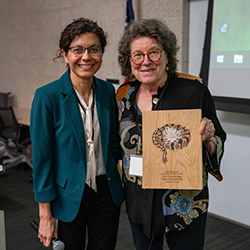
Dr. Leinwand’s research focuses on hypertrophic cardiomyopathy, the most common inherited heart disease and the leading cause of sudden death in young people. Her groundbreaking studies on the cardiac sarcomere, particularly the proteins myosin and myosin-binding protein C, paved the way for the first FDA-approved drug to directly target the molecular cause of this disease.
As someone who towed the line between academic and entrepreneurial activities, Dr. Leinwand shared how she bridged those two roles together in her career.
“There’s a lot of hope in the future for developing better therapy, particularly those directed at genetic diseases,” Dr. Leinwand said. “I’ve been a geneticist for a good part of my career and the first thing I did when I started my lab was map the family of striated muscle myosin genes.”
Dr. Leinwand’s knowledge of genetics and molecular physiology of heart diseases has led her to co-found MyoKardia, a biopharmaceutical company focused on developing targeted therapies for ailments such as hypertrophic cardiomyopathy.
After MyoKardia was acquired by Bristol Myers Squibb, Dr. Leinwand felt there was more work to be done toward developing therapies for heart ailments so she started another company called Kardigan.
“We’ve only been in business for two years, but we have a robust in-house research and development platform,” Dr. Leinwand said. “We’ve got clinical candidates that we have in license from other companies, and we’re now at 200 employees.”
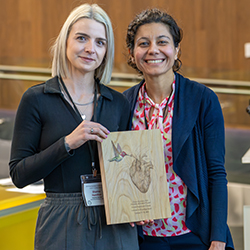
The final keynote speaker, Shanna Hamilton, PhD, assistant professor in the University of Arizona’s Department of Cellular and Molecular Medicine, spoke about finding new molecular targets to treat calcium-dependent arrhythmias.
Dr. Hamilton was the second recipient of the Arizona Physiological Society’s Innovator in Physiology Award. Dr. Doroudgar said Dr. Hamilton’s position as an outstanding mentor and role model makes her an excellent recipient for the award.
“Dr. Hamilton is an exceptionally creative and rigorous scientist whose work is transforming our understanding of cardiac calcium handling, oxidative stress and arrhythmia mechanisms,” Dr. Doroudgar said. “Since joining the University of Arizona in 2023, Dr. Hamilton has built a vibrant and collaborative research program at the intersection of biophysics, molecular cardiology and translational physiology.”
For her seminar, Dr. Hamilton discussed her laboratory’s focus on finding new molecular targets to treat calcium-dependent arrhythmias, which she said is the leading cause of death in the world for cardiovascular disease patients.
“What we’re trying to do in the lab is think a little outside the box,” Dr. Hamilton said. “Because RyR2 and calcium are so important for the contraction of the heart, we’re thinking of pathways that can indirectly attenuate RyR2 hyperactivity in disease.”
The two-day event concluded with a poster session, a business meeting and an awards ceremony. The complete list of award recipients is available on the Arizona Physiological Society website.
About the College
Founded in 2007, the University of Arizona College of Medicine – Phoenix inspires and trains exemplary physicians, scientists and leaders to advance its core missions in education, research, clinical care and service to communities across Arizona. The college’s strength lies in our collaborations and partnerships with clinical affiliates, community organizations and industry sponsors. With our primary affiliate, Banner Health, we are recognized as the premier academic medical center in Phoenix. As an anchor institution of the Phoenix Bioscience Core, the college is home to signature research programs in neurosciences, cardiopulmonary diseases, immunology, informatics and metabolism. These focus areas uniquely position us to drive biomedical research and bolster economic development in the region.
As an urban institution with strong roots in rural and tribal health, the college has graduated more than 1,000 physicians and matriculates 130 students each year. Greater than 60% of matriculating students are from Arizona and many continue training at our GME sponsored residency programs, ultimately pursuing local academic and community-based opportunities. While our traditional four-year program continues to thrive, we will launch our recently approved accelerated three-year medical student curriculum with exclusive focus on primary care. This program is designed to further enhance workforce retention needs across Arizona.
The college has embarked on our strategic plan for 2025 to 2030. Learn more.
By: Chase Congleton | January 6, 2026 | Original Post