
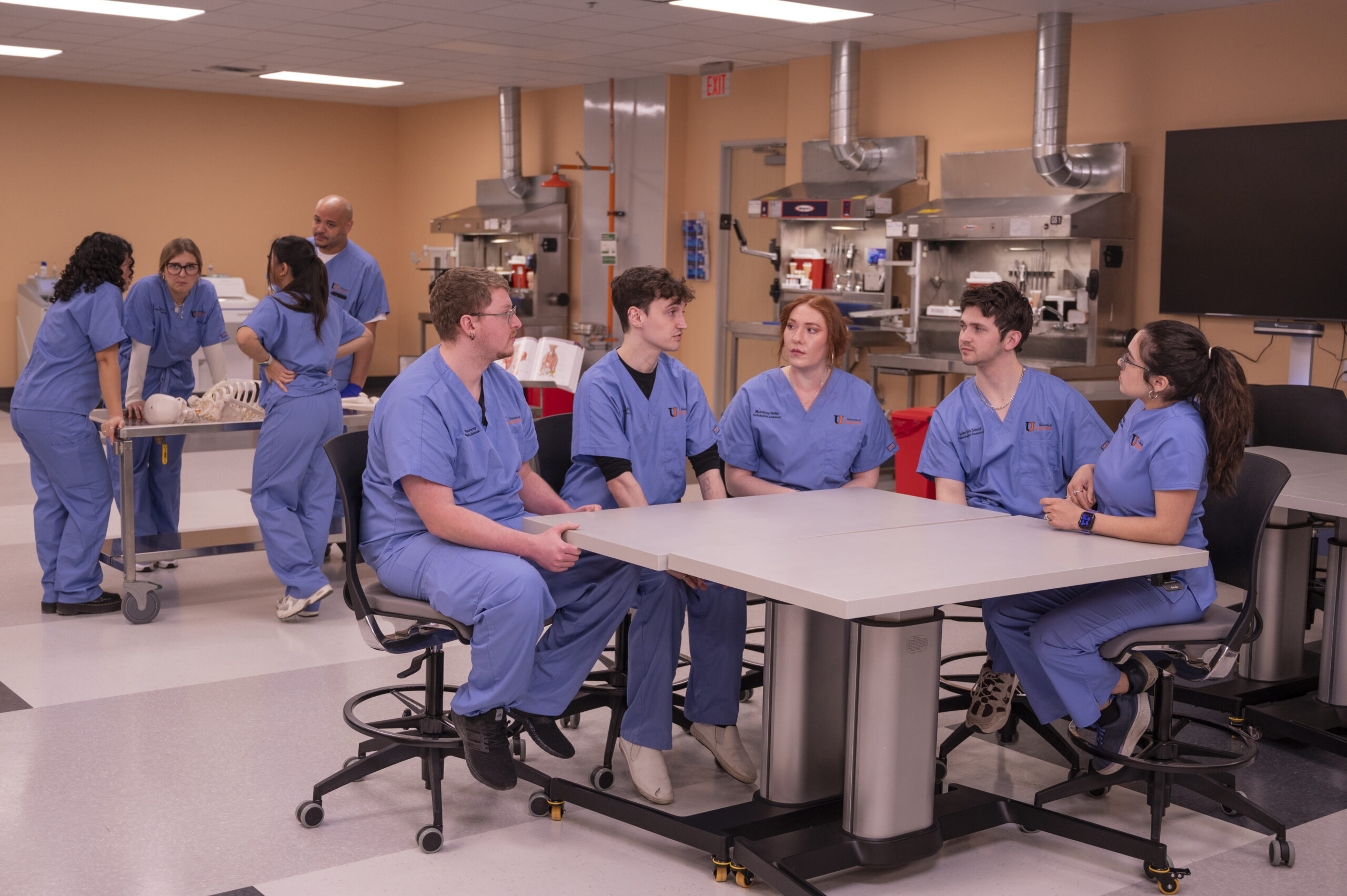
Kristin Lefebvre, PT, PhD, VPAA and Dean of Graduate Faculty, and Kerstin Leuther, PhD, Executive Director, InSPIRE from the University of Jamestown, say their experience and time in Phoenix has been defined by one thing: collaboration.
“Everyone has been incredibly welcoming and willing to help,” Lefebvre said. “Coming from the other regions, the environment can feel more territorial at times. Here, people are eager to share ideas and work together.”
The pair said they have been impressed by how connected Phoenix’s bioscience community is, from universities and startups to government leaders and research institutions. The level of engagement was especially evident at the opening of the University of Jamestown’s Health Sciences and Graduate Center, where representatives from across the local ecosystem gathered to welcome the institution to the community.
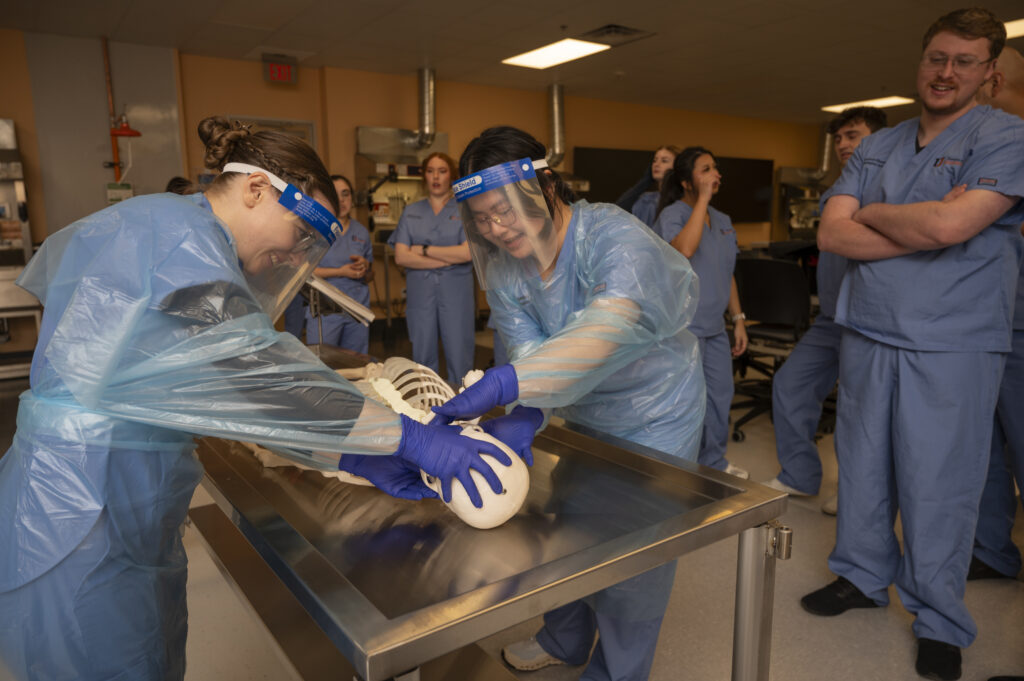
2026 Students in the Phoenix Pathology Lab, photo courtesy of Kristin Lefebvre
For Leuther, who previously worked in the San Francisco Bay Area, Phoenix’s ecosystem stood out as one of the few places where healthcare, research, and technology are connecting in a similarly collaborative way.
“As a scientist, I’m drawn to environments focused on research, healthcare, and development,” Leuther said. “Seeing universities, startups, and research organizations all working together here is something very unique.”
Building Talent and Research
As the University of Jamestown establishes a presence in Phoenix, leaders say their goal is not to replicate existing work in the region but to complement it.
“We want to understand where the needs are and help fill those gaps,” Leuther explained. “There’s already a lot of exciting work happening here, so our focus is on identifying where we can add value—whether that’s through training programs, research expertise, or workforce development.”
The university has increasingly focused on graduate and applied master’s programs that prepare students for careers in research and the biosciences industry. Programs include areas such as pathology, digital medicine, and clinical research.
“Our goal is to expand the talent pipeline for employers,” Lefebvre said. “By establishing roots in Phoenix, we can work closely with local companies and organizations to understand where talent is needed and help train students for those opportunities.”
The InSPIRE Program
The Institute of Sponsored Programs, Innovation, and Research Excellence (InSPIRE) serves as a catalyst for research, partnership, and workforce development at the University of Jamestown. InSPIRE connects faculty expertise, student talent, and external partners to turn strong ideas into funded, impactful research and sustainable collaboration.
InSPIRE is designed as an enabling platform that lowers barriers between discovery, funding, talent, and impact.
InSPIRE collaborates with external partners through sponsored research projects, co-funded pilot grants, workforce development programs, joint grant applications, and advisory or mentorship roles. These partnerships are designed to deliver value to all parties while strengthening the research ecosystem.
InSPIRE welcomes conversation with partners who share a commitment to discovery, impact, and opportunity. Together, we can build collaborations that advance research, prepare the next generation of talent, and create meaningful change.
A Student-Centered Approach
Lefebvre and Leuther highlight that prospective students interested in their programs should bring curiosity and a desire to apply their learning directly to real-world challenges.
“Come explore and ask questions,” Leuther said. “We’ve built programs designed around the skills students actually need to apply in their careers.”
One example is the university’s clinical research PhD program, which focuses on practical research skills.
“There’s no fluff,” Lefebvre said. “Students learn the fundamentals of research—things like critical literature review, ethics, and working with institutional review boards—while pursuing research in areas they’re passionate about.”
A Close-Knit Academic Community
One of the University of Jamestown’s defining characteristics is its close-knit culture.
“We know our students personally,” Lefebvre said. “I know every single one of our PhD students. Because we’re a smaller institution, relationships and mentorship are a core part of what we do.”
That culture was on display during a recent research symposium in Phoenix, where many doctoral students traveled at their own expense to connect with peers and faculty.
“They wanted to be here to support each other and build that network,” Lefebvre said. “That sense of community is a big part of who we are.”
The university refers to its students and alumni as “Jimmies,” a nod to its mascot and the culture the institution has cultivated.
“Being a Jimmie really means something,” Leuther said. “It represents a community that cares.”
Both Lefebvre and Leuther showcased that the commitment extends beyond mentorship. Many leaders throughout the university bring industry experience into the classroom, helping students navigate careers in research, healthcare, and bioscience.
“We care deeply about our students and where they’re headed,” Leuther said. “We’ve worked in academia, industry, and research ourselves, so we understand the paths they’re pursuing—and we’re here to help them get there.”
About the Phoenix Bioscience Core
The Phoenix Bioscience Core (PBC) is a 30-acre life sciences innovation district located in downtown Phoenix. It hosts Arizona’s three public research universities—Arizona State University, Northern Arizona University, and the University of Arizona—as well as leading genomics pioneers like the Translational Genomics Research Institute (TGen), part of the City of Hope, and the International Genomics Consortium. The PBC also collaborates with major healthcare systems, including Banner Health, Phoenix Children’s Hospital, Dignity Health, HonorHealth, Phoenix VA, and Valleywise Health, alongside a growing number of emerging life science companies. This unique concentration of research scientists and healthcare professionals fosters unprecedented collaborations, advancing precision medicine from discovery to delivery. To learn more, please visit phoenixbiosciencecore.com
By: Madisson Simental | March 19, 2026