


Dr. Chiamvimonvat will use the funding to advance her studies on ion channels
A physician-scientist recognized for influential contributions to the field of cardiac arrhythmias, bridging mechanistic studies with clinically relevant questions, and chair of the Department of Basic Medical Sciences at the University of Arizona College of Medicine – Phoenix, Nipavan Chiamvimonvat, MD, was recently awarded the National Heart, Lung and Blood Institute (NHLBI) of the National Institutes of Health (NIH) *Outstanding Investigator Award (OIA, NIH R35), a prestigious seven-year research grant.
Up to 20 grants per year are awarded by NHLBI to established investigators across the nation. Through the award, the OIA will support and provide Dr. Chiamvimonvat the freedom to conduct research that breaks new ground or extends previous discoveries in new directions. It will also allow the investigators to take greater risks and to pursue research that requires a longer time frame, that are within the scope of the NHLBI mission.
Dr. Chiamvimonvat’s current research is exploring ion channels — a large family of proteins that are critical for all normal cell types in the body, as well as abnormal cells like cancer cells. “They serve as the crucial gateways for the entry and exit of ions (salts) in and out of the cells, that are necessary for cellular excitability and cell to cell communications,” said Dr. Chiamvimonvat.
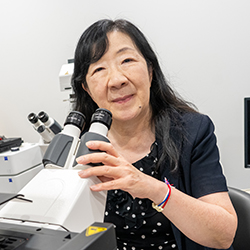
Her laboratory has made foundational contributions to ion channel biology in cardiovascular system, and the critical roles of small conductance Ca2+-activated K+ channels (SK channels) in atria and pace-making cells. In addition, her laboratory was the first to demonstrate the beneficial effects of a novel class of inhibitors of the key enzyme in the arachidonic acid metabolisms in heart failure and atrial arrhythmias.
“We demonstrated unequivocally that several types of SKchannels play critical roles in the heart, at a time when SK channels were thought to be restricted only to neurons,” Dr. Chiamvimonvat explained.
Since those original reports, the field’s knowledge of cardiac SK channels has expanded dramatically. Studies by her group — and, more recently, by others — have substantiated the essential roles of SK channels in the heart. “More germane and pragmatic findings supported the critical roles of SK channels in human arrhythmias (abnormal heart rhythm) and atrial fibrillation, the most common arrhythmia seen clinically. SK channels may represent a novel therapeutic target for atrial arrhythmias,” she said.
Moreover, SK channels are the only K+ channels upregulated in heart failure, while other K+ channels are reduced, underpinning their importance in diseased hearts. “Our findings have spurred the development of SK channel inhibitors in clinical trials to treat atrial fibrillation; a gratifying outcome yielded from mechanistic studies,” Dr. Chiamvimonvat said.
In accordance with this work, Dr. Chiamvimonvat and her team — Miao Zhang, PhD, an associate professor and a structural biologist, Jeong Han Lee, PhD, an expert in mechanosensation, early-stage investigators, Ryan Woltz, PhD, and Yang Zheng, PhD, as well as Vladimir Yarov-Yarovoy, PhD, Heike Wulff, PhD, and Igor Vorobyov, PhD, and their long-term collaborators at the University of California, Davis — are currently working toward developing novel therapeutics for atrial fibrillation, exploiting New-Approach Methodologies (NAM) using combined computational, structural, and functional studies.
“Our hope is to pioneer the identification of relevant mechanisms underpinning cardiac excitability and arrhythmias,” Dr. Zhang said.
“And this study represents the necessary and critical steps to disentangle the multifaceted SK channel function, the unique K+ channels that play critical roles in human atrial fibrillation but also help to compensate for the ‘reduced repolarization reserve’ in heart failure,” Dr. Chiamvimonvat added.
If their hypotheses show the promise they expect, the clinical ramifications are vast and far-reaching, leaving little doubt that the outcome would be significant in advancing the field.
The purpose of the OIA is to promote scientific productivity and innovation by providing long-term support and increased flexibility to outstanding principal investigators, whose extraordinary record of research demonstrates their ability to make major contributions to heart, lung, blood and sleep (HLBS) research. The OIA supports an investigator’s research program, rather than a research project, by providing the primary source of NHLBI funding.
By Thomas Kelly | October 12, 2026 | Original Article
About the College
Founded in 2007, the University of Arizona College of Medicine – Phoenix inspires and trains exemplary physicians, scientists and leaders to advance its core missions in education, research, clinical care and service to communities across Arizona. The college’s strength lies in our collaborations and partnerships with clinical affiliates, community organizations and industry sponsors. With our primary affiliate, Banner Health, we are recognized as the premier academic medical center in Phoenix. As an anchor institution of the Phoenix Bioscience Core, the college is home to signature research programs in neurosciences, cardiopulmonary diseases, immunology, informatics and metabolism. These focus areas uniquely position us to drive biomedical research and bolster economic development in the region.
As an urban institution with strong roots in rural and tribal health, the college has graduated more than 1,000 physicians and matriculates 130 students each year. Greater than 60% of matriculating students are from Arizona and many continue training at our GME sponsored residency programs, ultimately pursuing local academic and community-based opportunities. While our traditional four-year program continues to thrive, we will launch our recently approved accelerated three-year medical student curriculum with exclusive focus on primary care. This program is designed to further enhance workforce retention needs across Arizona.
The college has embarked on our strategic plan for 2025 to 2030. Learn more.