

Armed with curiosity and lab coats, the 2025 Class of the KEYS Research Internship didn’t just observe science; they shaped it. Read 12 of their stories.

2025 Tuscon KEYS intern Azani Anderson helps collect plant root samples at the University Arizona Campus Agricultural Center. Lily Howe, BIO5 Institute
Through the BIO5 Institute’s KEYS Research Internship this summer, 65 high school interns joined University of Arizona labs, including for the first time a new Phoenix cohort alongside those in Tucson and virtual placements.
Over seven immersive weeks, KEYS interns became active scientific contributors. They gathered real data, asked bold questions, and sparked new ideas in their labs.
Along the way, they built skills in lab techniques, data science, and science communication while working side-by-side with University of Arizona researchers on projects in neuroscience, plant biology, diabetes care, women’s health, and more.
Meet some of the 2025 KEYS interns and their mentors—partners in discovery whose shared work drives innovation and inspires lasting impact.
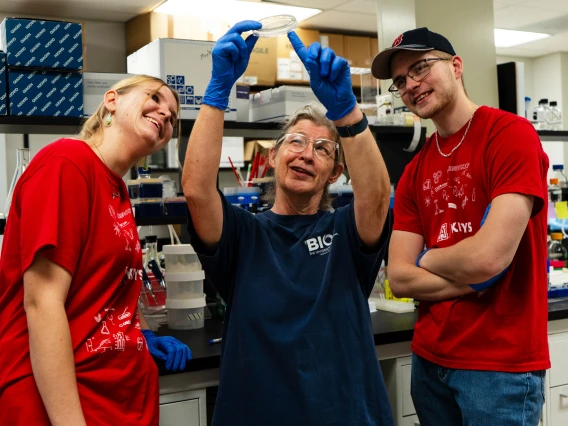
Building DNA tools to study the aging brain
Tucson KEYS interns Ana Bradley (she/her) and Tyler Johnston (he/him) explored how aging affects brain function, especially neurodegenerative diseases, in Haining Zhu lab.
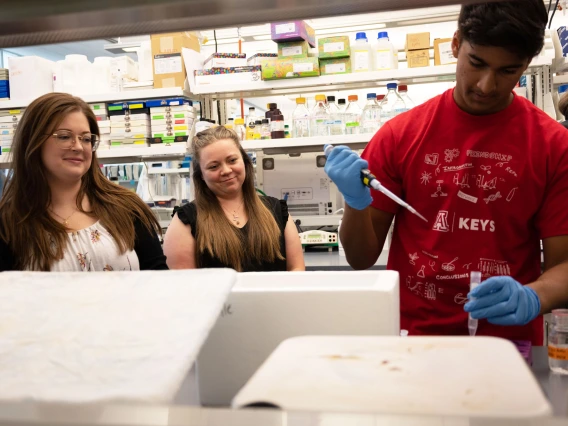
Connecting biology to better heart treatments
2025 Phoenix KEYS intern Adi Tyagi (he/him) studied how female and male heart tissue reacts to stress and inflammation in the lab of Taben Hale.

Cracking the code behind hearing loss
2025 Phoenix KEYS intern Ayana Jain (she/her) worked in the lab of Isabelle Schrauwen and studied the genetic causes of rare hearing conditions that begin before birth.
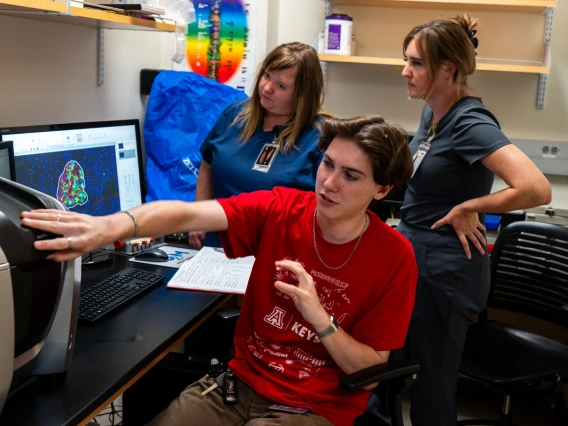
Engineering a better future for diabetes care
2025 Tucson KEYS intern AJ Shaffer (he/him) assisted the lab of Klearchos Papas in the development of a new kind of treatment for Type 1 diabetes that could free patients from daily insulin injections.

Exploring how the brain weighs risk and reward
2025 Phoenix KEYS intern Shivani Satheeshkumar (she/her) studied how the brain helps us make split-second decisions in the lab of Melissa Warden.

Illuminating the roles of cells in the heart
2025 Phoenix KEYS intern Akaisha Bahrie (she/her) learned how to use flow cytometry, a powerful technology that tags cells with glowing markers to analyze complex tissues, under the mentorship of Mrinalini Kala.

Mapping microbes that influence women’s health
2025 Phoenix KEYS intern Matthew Hawkins (he/him) study a little-known bacterium to better understand its role in the uterus in the lab of Melissa Herbst-Kralovetz.

Measuring roots to improve crops from the ground up
Tucson 2025 KEYS intern Azani Anderson (they/he) helped validate the Alexander Bucksch lab’s new 3D computer model that measures this root growth in detail.

Studying symbiosis to tackle agricultural pests
2025 Tucson KEYS interns James Jirousek (they/he) and Sara Porter (she/her) explored the mutually beneficial relationship, or symbiosis, between insects and bacteria in the Martha Hunter lab.
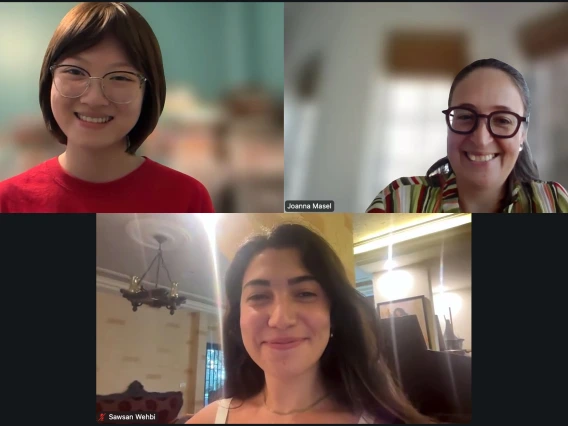
Tracing the origins of life with code
2025 virtual KEYS intern Hannah Lou (she/her) used large genetic databases to study how life began in the lab of Joanna Masel.

Training algorithms to spot cancer
2025 Tucson KEYS intern Ethan Hancey (he/him) combined optics and artificial intelligence to advance cancer detection in the lab of Travis Sawyer.

Tracking the signals plants use to fight back
Tucson KEYS intern William Jacobsen (he/him) tested how corn plants respond to different combinations and timing of green leaf volatiles signals in the lab of Chris Frost.
By: Caroline Mosley Bartelme | July 31, 2025 | Original Post